I Built an AI Interviewer as a Student with ₹0 Budget. Here’s the Full Stack.
A build-in-public breakdown of IntervYOU—architecture, honest numbers, and why auto-silence detection was the hardest part.
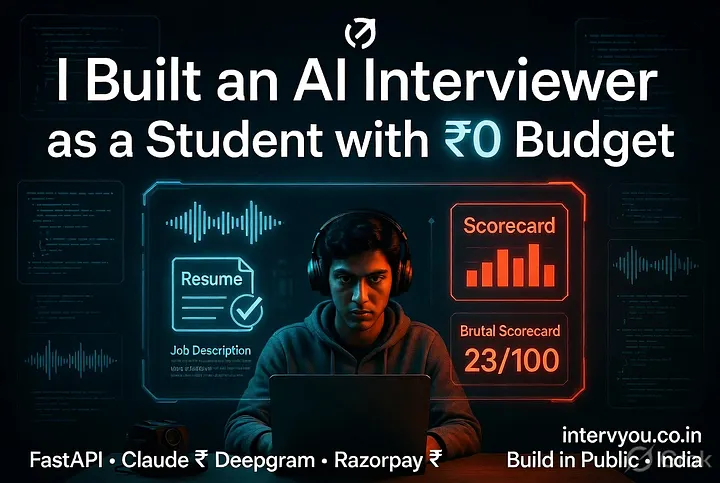
Six months ago I was a student with a broken interview experience and no money to fix it. Today, IntervYOU (intervyou.co.in) is a live, working AI interview platform with real users, a payment system, automatic refunds, and a shareable scorecard feature.
Here is the build-in-public breakdown of the tech stack, the architecture, and the honest business numbers.
The Problem I Was Solving
Standard mock interview prep today has two flawed options:
- Human Mocks: Expensive (₹500–2000) and hard to schedule.
- ChatGPT/Claude: Zero pressure, zero voice, and zero realism. You can stare at the screen for 5 minutes composing a perfect answer. In a real interview, you have 3 seconds of silence before it gets awkward.
The Full Tech Stack
I chose tools that prioritized speed of development and high reliability:
- Backend: FastAPI (Python) — Chosen for its async support and performance. Handles session state and payment logic.
- Auth: Supabase — Email + Google OAuth with Row-level security for total data isolation.
- AI / LLM: Claude (Anthropic) — Used for its superior ability to generate adaptive questions and evaluate complex technical answers.
- Speech-to-Text: Deepgram — Transcribes user voice in near real-time.
- Text-to-Speech: Deepgram TTS — Delivers the AI’s questions with incredibly low latency.
- Payments: Razorpay — Handles the ₹12 entry fee and automatic refund logic triggered via API.
The Architecture: A Voice-First Agentic Loop
The core interview engine isn't a simple chatbot; it's a state-managed loop:
- Context Loading: User uploads a Resume PDF + Job Description.
- Planning: LLM reads both and plans N questions with a difficulty curve.
- Delivery: Question is converted to voice and spoken out loud.
- Active Listening: User mic activates; Auto-silence detection waits for a 2.5s pause to auto-submit the answer.
- Evaluation: LLM evaluates the audio transcript and decides whether to follow up or move to the next topic.
- Closing: Final score (0-100) and a brutally honest AI verdict are generated.
The Business Model (Honest Numbers)
Transparency is key in the build-in-public community. Here is what it costs to run one interview:
- LLM (Claude API): ~₹1.5 — ₹3
- Deepgram (STT + TTS): ~₹1.0
- Server/Hosting: ~₹0.2
- Total Cost: ~₹2.7 — ₹4.2 per session
The Revenue Model: Users pay ₹12. If they pass (score ≥ 60%), we refund ₹10 automatically. We keep ₹2 to cover API costs. If they fail, we keep ₹12. The real value for the user is the performance report that finds the gaps they didn’t know they had.
Marketing: The Power of Organic Reach
- Shareable Scorecards: After every interview, users get a dark-themed image card. It’s designed to be "LinkedIn-ready," creating organic growth through every user share.
- Coupon Strategy: We use code FIRSTFREE to remove all payment friction for first-time users.
- Medium & Content: Writing technical articles like this creates search discoverability that lasts longer than any social post.
What I’d Do Differently
- Refactoring: Build the score structure first. I built the flow before I had a structured score output, which made adding the refund logic difficult later.
- Social Proof: Don’t fake it. I initially had "Join thousands" on the landing page with zero users. I removed it immediately. Honest copy converts better.
- Indian Candidate Support: Deepgram is excellent for English, but my next major update is integrating Sarvam AI. Most Indian candidates speak in "Hinglish," and Sarvam’s support for 22 Indian languages is a game-changer for accessibility.
Final Status: IntervYOU is live and shipping. If you're a developer building in public, reach out—I'm happy to share the journey.
Try it now at intervyou.co.in (Code: FIRSTFREE).