How to Practice Job Interviews with AI in 2026 — Complete Guide
You solved 300 LeetCode problems. You know your tech stack cold. But the moment a real interviewer asks you to explain your architecture — you freeze. Here's how AI interview practice fixes that, and why it's the fastest-growing skill-building method of 2026.
1. Why Traditional Interview Prep Is Failing You
Every year, millions of skilled developers, engineers, and graduates fail interviews they were technically ready for. The problem isn't knowledge. The problem is the gap between knowing and articulating under pressure.
Traditional preparation methods were designed for a world that no longer exists:
- Reading interview questions — You read, you understand, you feel ready. Then someone asks you live and your brain goes blank.
- Typing into ChatGPT — You have unlimited time, no pressure, no voice. It's the opposite of a real interview.
- Peer mock interviews — Awkward, hard to schedule, and your peer is as nervous as you are.
- Paid human coaches — ₹500 to ₹2000 per session. Unsustainable for the volume of practice you actually need.
"The skill of a real interview is not knowing the answer. It's starting to speak within 3 seconds of hearing the question — with your brain still processing it."
None of the above methods train this skill. AI interview practice does.
2. What Is AI Interview Practice?
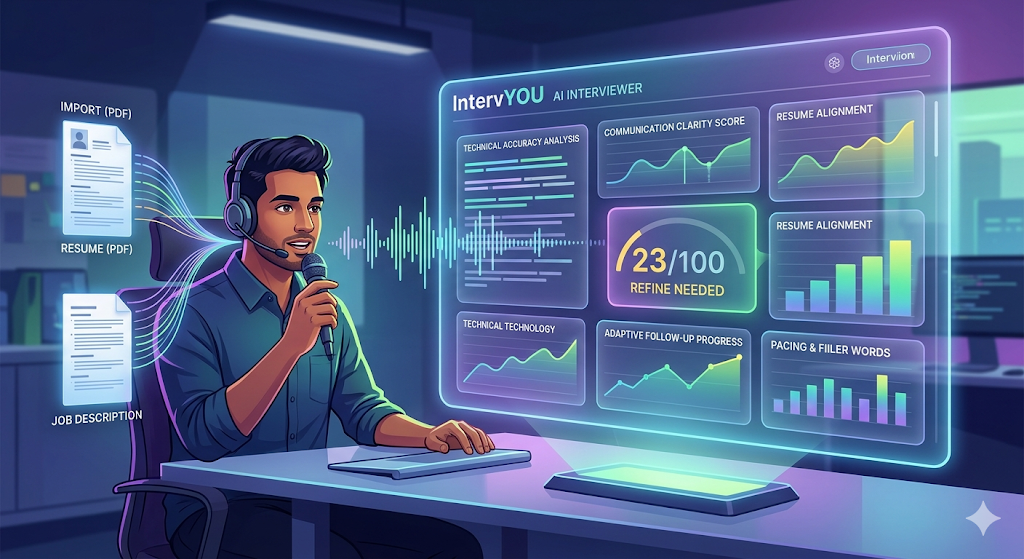
AI interview practice is the use of artificial intelligence to simulate realistic, adaptive job interviews. Unlike static question banks or chatbots, modern AI interview platforms conduct actual conversations — asking questions, listening to your answers, and following up based on exactly what you said.
The best AI interview practice tools in 2026 share these characteristics:
- Resume-aware questioning — The AI reads your actual resume and asks about your specific projects, not generic questions.
- Job description alignment — Questions are tailored to the exact role you're applying for.
- Adaptive follow-ups — When you say "I used FastAPI for the backend," it asks "Why FastAPI over Django? How did you handle async database calls?"
- Real-time voice interaction — No typing. You speak. The AI listens.
- Immediate feedback — After the session, you get a score, breakdown, and specific improvement tips.
3. Voice AI vs Text-Based AI — Why the Difference Matters
Most candidates make a critical mistake: they use text-based AI (ChatGPT, Claude, Gemini) to practice for voice interviews. This is like practicing swimming on dry land.
| Feature | Text AI (ChatGPT etc.) | Voice AI (IntervYOU etc.) |
|---|---|---|
| Time to answer | Unlimited | Real-time pressure |
| Communication medium | Typing | Speaking |
| Interruptions | None | Adaptive follow-ups |
| Tone & delivery feedback | Not possible | Included |
| Psychological pressure | Zero | Simulated |
| Resume awareness | Manual only | Automatic |
The moment you speak your answer instead of typing it, you discover a new set of problems — filler words, trailing off, starting strong but losing the thread. These are the problems that cost candidates real job offers. Text-based prep never reveals them.
Try AI Interview Practice Free
Upload your resume. Speak your answers. Get a brutal honest score in under 10 minutes.
Start Free with Code FIRSTFREE →4. How to Use AI to Practice Job Interviews — Step by Step
Here is the exact process to get maximum benefit from AI interview practice:
Step 1: Choose a voice-first AI interview platform
Don't use a text chatbot. You need a platform specifically built for voice-based interview simulation. IntervYOU (intervyou.co.in) is built exactly for this — it conducts real voice interviews based on your resume.
Step 2: Prepare your inputs (5 minutes)
Before starting, have two things ready: your latest resume (PDF) and the job description of the role you're targeting. The AI uses both to generate relevant, personalized questions. This is not a generic quiz — it's a targeted interrogation based on your actual background.
Step 3: Do the interview in a quiet place
Treat it like a real interview. Sit upright. Use headphones. Speak clearly. The psychological environment matters — if you practice casually, you'll perform casually in the real one.
Step 4: Don't pause the interview
When you don't know the answer, say "Let me think through this step by step" and work through it out loud. This is what real interviewers want to see. Pausing and restarting teaches you nothing about handling the actual pressure.
Step 5: Review your feedback report carefully
After the session, read every section of the feedback. Focus on the areas marked weakest. Don't just celebrate the score — the detailed breakdown is where the real value is. What did you say that made the AI downgrade your technical accuracy score? What filler words appeared most? How was your structure?
Step 6: Repeat — 3 sessions minimum before a real interview
The first session shows you your gaps. The second session starts to close them. The third session builds confidence. Don't walk into a real interview with only one practice session under your belt.
5. Best AI Interview Practice Tools in India (2026)
The AI interview practice market has grown significantly in 2026. Here's an honest comparison of the main options available to Indian candidates:
| Platform | Voice-based | Resume-aware | India pricing | Feedback report |
|---|---|---|---|---|
| IntervYOU | Yes | Yes | ₹12/session | Detailed |
| ChatGPT / Claude | No (text only) | Manual | Free / $20/mo | None |
| Pramp | Peer video | No | Free (limited) | Peer feedback |
| Interviewing.io | Peer video | No | $225/session | Detailed |
For Indian candidates preparing for technical roles, IntervYOU offers the best combination of voice-based AI interaction, resume intelligence, and affordable pricing. The ₹12 skin-in-the-game model also creates the psychological pressure that free tools lack.
6. 7 Tips to Get the Most from AI Interview Practice
- Practice the first 30 seconds of every answer. The opening of your response sets the tone. Practice starting with a clear one-sentence summary before you go into detail. "The core issue here is X, and here's how I approached it."
- Record yourself separately if possible. Hearing your own voice back reveals patterns — filler words, upspeak, pacing — that you don't notice while speaking.
- Deliberately practice your weakest area. Don't just do full interviews every time. If your technical accuracy score is low, focus a session entirely on explaining your tech stack clearly.
- Practice with different job descriptions. An AI interview for a "Backend Engineer" role will feel very different from one for a "Full Stack Developer." Run sessions for each type of role you're targeting.
- Don't over-prepare specific answers. Memorized answers break down under follow-up questions. Practice thinking out loud, not reciting.
- Use the feedback to rewrite your resume talking points. If the AI consistently finds gaps in how you explain a particular project, rewrite how you describe that project — in your resume and verbally.
- Do a session 24 hours before the real interview. Not on the morning of — you want to be fresh, not in practice mode. 24 hours before is the sweet spot.
"You explained the concept like you were reading it off a wall — technically present, emotionally absent."
7. AI Interview Practice for Freshers — Why It Matters More
If you are a fresher — a student or recent graduate entering the job market for the first time — AI interview practice is not optional. It is the single highest-leverage activity you can do in the month before placements.
Here's why freshers specifically benefit:
- You have zero real interview experience. The first time you face a live interview should not be the first time you've spoken about your projects under pressure.
- Campus placements are competitive and fast-paced. Companies conduct multiple rounds on the same day. AI practice builds the stamina and reflexes for back-to-back interviews.
- Your resume projects are your only differentiator. AI interview practice specifically tests how well you can explain what you actually built — not just what you read.
- Confidence is built through repetition, not reading. You cannot think your way to interview confidence. You have to speak your way there.
The biggest mistake freshers make is thinking they'll "figure it out" in the actual interview. You won't. The real interview is not the place to discover that you go silent when asked "Why did you use this approach over alternatives?" Practice that question a hundred times before it counts.
Ready to Practice with AI? Start Free Today.
Upload your resume. Get grilled by AI on a live voice call. Receive a detailed score and feedback report. Use code FIRSTFREE — no card needed.
Try IntervYOU Free →intervyou.co.in · Code: FIRSTFREE · No credit card required
8. Frequently Asked Questions About AI Interview Practice
AI interview practice is using artificial intelligence to simulate realistic job interviews. Modern platforms like IntervYOU use voice AI to ask questions, evaluate your answers in real time, and give detailed feedback — just like a human interviewer would, but available 24/7 at a fraction of the cost.
Both have value, but for different reasons. AI mock interviews win on availability (24/7), cost (₹12 vs ₹500-2000), consistency (no bad days), and volume (practice as many times as you need). Human mock interviews offer emotional nuance and subjective judgment. For the practice volume required to build real interview confidence, AI is more practical.
Yes. IntervYOU offers a free first AI mock interview with code FIRSTFREE at intervyou.co.in. No credit card required. You get a full 10-minute voice interview, real-time AI questioning, and a detailed feedback report.
You upload your resume and paste a job description. IntervYOU's AI reads both, plans custom interview questions tailored to your background, and conducts a real-time voice interview. You speak your answers, the AI listens, evaluates, and asks intelligent follow-up questions. After the session, you receive a score (0-100) and a detailed breakdown of communication, technical accuracy, and areas for improvement.
IntervYOU (intervyou.co.in) is among the best AI interview practice tools built specifically for Indian developers and job seekers. It uses voice AI, supports resume-based adaptive questioning, is priced for the Indian market (₹12/session), and provides a shareable scorecard after each session.
IntervYOU charges ₹12 per interview session. If you score above 60%, you receive ₹10 automatically refunded — so high performers essentially practice for ₹2. Use code FIRSTFREE for your very first interview at zero cost.
Absolutely. AI interview practice is especially valuable for freshers who have never experienced a real interview. It removes the fear of freezing, helps articulate technical knowledge verbally, and builds confidence through repetition — before the actual placement interview where stakes are high.
Final Thoughts: Stop Practicing Wrong
The interview landscape changed when AI became capable of conducting real-time voice conversations. The candidates who understand this — and use AI interview practice as their primary preparation method — will have a significant edge in 2026 placements and job markets.
If you take nothing else from this guide, take this: the goal of interview preparation is not to know more. It is to articulate what you already know, under pressure, out loud, in real time.
The only way to build that skill is to actually do it — repeatedly, with feedback, under realistic conditions.
That's what AI interview practice is for.
Start Your First AI Interview Now
10 minutes. Your resume. Real voice pressure. Honest feedback.
Get Started Free — Code: FIRSTFREE